
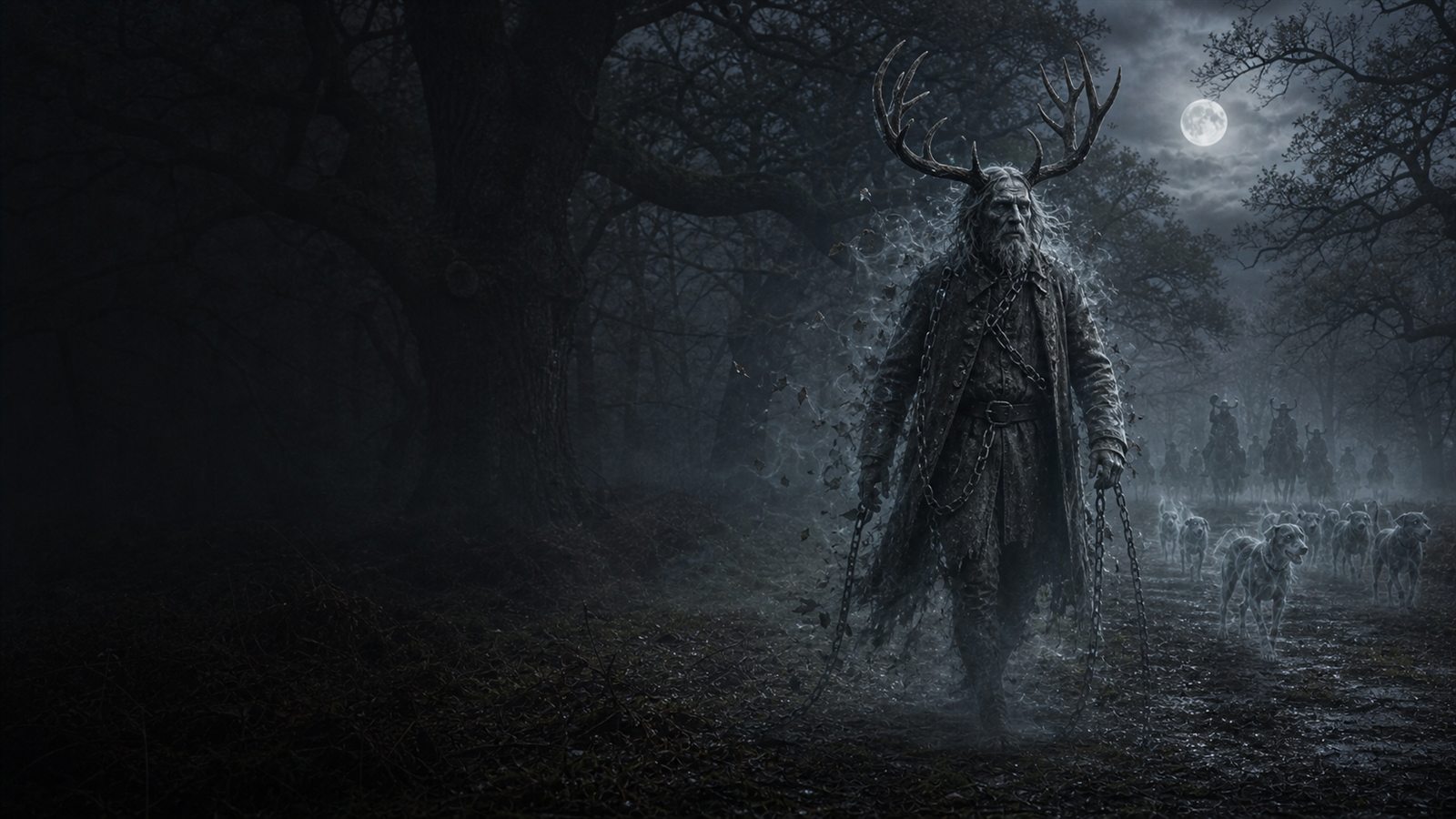
Herne the Hunter appears by name in Shakespeare's Merry Wives of Windsor (1597), where a character describes him as a gamekeeper who hanged himself from an oak in the park and now haunts it as a ghost with great ragged horns, blasting the trees and taking cattle. Whether Shakespeare invented the figure or drew on a genuine Windsor tradition is unknown — but the legend took root after him and grew.
He now haunts it as a ghost with great ragged horns, blasting the trees and taking cattle.
The ghost beneath the oak
Herne's Oak, the specific tree he was said to haunt, was pointed to and venerated for centuries. One candidate was felled by order of George III in 1796; another, identified during Queen Victoria's reign, fell in a storm in 1863. Victoria herself had a new tree planted as a replacement, demonstrating both the persistence of the tradition and the crown's willingness to accommodate it. The park keeps its Herne's Oak.
The wider question of Herne's origins connects him to the Wild Hunt tradition — spectral hunts of the dead that cross the sky and countryside in European folklore — and to the horned god figure whose presence in British prehistory is evidenced from the antlered figure at Cerne Abbas to the carved head at Rhenish altars. Whether Herne is a specific ghost, an echo of a forest deity, or a confluence of both, he remains one of the most compelling supernatural figures in southern English tradition.